Assorted reflections on the oral
teachings of Rabbi Schneur Zalman of Liadi
Monday, November 30, 2015


Tuesday, November 25, 2014
The Idealistic Realism of Jewish Messianism
The real deal on Chabad’s apocalyptic calculations, and why Jews have always predicted elusive ends.
The suspicion with which Jewish messianism is often regarded may well stem from the apparent contradiction it embodies. To await the Messiah is to live a life marked by optimistic anticipation for an unimaginably brighter future. But to live as a Jew requires full immersion in the demands of the present moment. The false-messiahs that litter the history of Jewish exile are nothing other than the failure of real events to live up to idealistic hopes. And yet a Judaism stripped of messianic inspiration is inconceivable. It is precisely such inspiration that has continued to sustain us despite all the trying upheavals of the ages.
For messianism to be authentically Jewish, and for it to inspire an authentically Jewish future, it must somehow bridge the gap between idealism and realism. As the writer, philosopher and critic Leon Wieseltier has put it, “Messianism is commonly interpreted as a variety of idealism. But if idealism is only a part of Judaism’s attitude towards the world, messianism must stand in a relationship also to realism.”
Thursday, September 11, 2014
The Berlins of Oxford and their Opposing Origins in Tsarist Russia
 |
| Isaiah Berlin and his wife Aline aboard a ship, 1957, Isaiah Berlin Literary Trust |
Last month Aline de Gunzbourg, the wife of Isaiah Berlin, passed away at the age of 99 (see obituaries here and here). Both Aline and Isaiah were scions of the Jewish philanthropic aristocracy of 19th century Russia. Aline's grandfather, Baron Horace de Gunzbourg (aka Ginzberg or Günzburg), was the most prominent backer of the Society for the Promotion of Enlightenment Among the Jews of Russia. In other words, a leading proponent of acculturation and secularization. Originally Isaiah's family name was Zuckerman, but his father Mendel took the surname of his great uncle and patron, the prominent Chabad industrialist and philanthropist Yeshayeh (Isaiah) Berlin, whose first name Mendel later gave to his son.
Yeshayeh Berlin was not only a follower of Chabad chassidism and a leading backer of the fifth rebbe of Chabad-Lubavitch, Rabbi Shalom DovBer Schneersohn (Rashab), in his battle to combat acculturation and preserve traditional Jewish life. Yeshayeh Berlin was also married to the Rebbe's first cousin, Chayetta. Both were grandchildren of the third rebbe of Chabad-Lubavitch, Rabbi Menachem Mendel Schneersohn (the Tzemach Tzedek). Chayetta's sister Frumma was Isaiah Berlin's great grandmother.
In short, the Berlins of Oxford were descendants of two opposing ideological factions within the uppermost the philanthropic Jewish aristocracy of Tsarist Russia. Despite the ideological opposition the Schneersohns and Berlins maintained cordial relationships with the de Gunzbourg family, and worked together with them on economic and humanitarian projects of mutual interest. One example, which I wrote about here, was the Chinese matzah campaign of 1905. Although Baron Horace de Gunzbourg initially declined Rabbi Shalom DovBer's plea for help in this endeavor, the latter latter suggested that the former's son, Baron David de Gunzbourg be invited to chair the campaign committee.
Isaiah Berlin was well aware of his illustrious chassidic lineage, but not at all acquainted with the intellectual and cultural riches of his chassidic heritage. His father, Mendel, fled to London following the communist takeover of Russia, but remained well connected with the Chabad leadership until his parents and inlaws were murdered following the Nazi conquest of Riga, circa 1941.
Berlin himself appears to have met the sixth Rebbe of Chabad, Rabbi Yosef Yitzchak Schneersohn, while in Marienbad in the Summer of 1933 (see Isaiah Berlin,Letters Vol 1. [1928-1946], page 56, and Rabbi Yosef Yitzchak Schneersohn, Igrot Kodesh Vol. 3, page 43). In the aftermath of World War Two and the holocaust the family connection was eroded, and Isaiah's impressions of chassidism were too distant and superficial for him to pursue any remaining ties. But Mendel still looked back to the heyday of the Berlin family with nostalgia. In an eighty-six page manuscript dating from 1946 (held today by the Bodleian Library at Oxford, MS. Berlin 819 and MS. Berlin 820) he transcribed his own history, and the history of his chassidic forebearers. He also called upon his son to renew his connection with his roots, apparently to little avail.
For more on the history of the Berlin family see the first chapters of Isaiah Berlin: A Life by Michael Ignatieff.
The following is an abstract of my related article, reflecting a dialogue between Berlin's essay The Hedgehog and the Fox and Chabad thought, as recently published in Hakirah:
Identity and meaning hang upon the balance that must be struck between the two poles of unity and multiplicity. According to Isaiah Berlin this existential dilemma lies at the heart of Tolstoy’s great epic, War and Peace. All people that are not superficial believe in some kind of cohesive vision. But when the threads of life start to unravel even the wisest of men may be rendered mute. In The Gate of Unity and Faith Rabbi Schneur Zalman of Liadi expands the quintessence of faith into the circle of reason, and fits the square of dissonance into the circle of life.See also this related article by Rabbi Eli Brackman of Chabad at Oxford University: The convergence of the philosophy on liberty of Sir Isaiah Berlin and the Lubavitcher Rebbe.
Saturday, February 1, 2014
The Writing Experience - Finding the Right Words
As much as he was a chassidic rebbe, Rabbi Yosef Yitzchak Schneersohn (known as the Rebbe Rayatz or Friediker Rebbe) also epitomized what it means to be a chassidic man of letters. The following is an extract from a discourse in which he describes the experience of turning lofty ideas into readable prose. As a writer it struck a personal chord with me, and I don't think it is overly presumptive to detect an autobiographical note on Rabbi Yosef Yitzchak's own part. This is a free translation of Sefer Hamaarim 5711, page 29-30, the discourse in question was first delivered in 1933.

When revealing an intellectual matter or deep wisdom in writing, the hand writes what rises in the depth of his intellect with all the logical details of that intellectual idea. At that moment he has great pleasure from his grasp of that intellectual concept, and a great desire to explain it in in clearly written prose, each matter in its place, in systematic order. This is achieved specifically through his analysis and introspective contemplation while writing, attempting to find the phraseology and the precise language through which the deep concept will be revealed with clarity, without any mistake falling into any one of the logical elements. Through the power of his thoughts and his contemplation he finds such words that fit that deep concept, encompassing all the details of his logical idea in all their sharpness and precision.
All the loftiest and most integral abilities and talents of his soul take a part in this. Mind and heart unite and act as one. Their unity is such that that each is effected by the other, though they are opposites by their essential nature. Mind and heart are respectively water and fire by their essential nature... the intellect is cold and collected, and emotion is hot and excitable. But in this unity the cold intellect is effected by the essence of emotion, becoming hot and burning with inspiration of the soul and the desire to reveal this deep concept. Likewise, the excitable heart is influenced by the essence of intellect to organize its experience in introspective thought and contemplation, in order to find the expressions and expressive language that are most fitting to reveal with deep clarity the logic of this deep concept.
The capacities of the inner mind and heart join together in this activity. Although each of them is an entity of its own, they nevertheless reside in one place. Intellect, pleasure, will, thought, inspiration, and desire combine with one another and complement one another, and all as one join in this activity.
Tuesday, February 19, 2013
Chassidic Dance
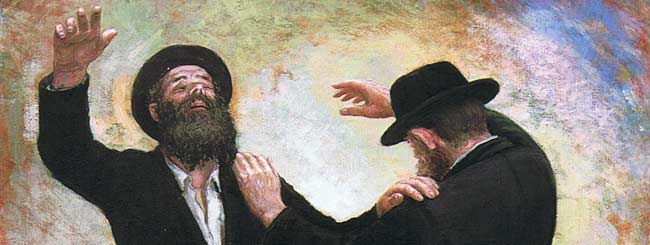 |
| "no longer a dance, but a kind of silent prayer, offered by a body of flickering flame..." |
The following is translated from the Prologue to Fishel Schneersohn's novel, Chaim Gravitzer:
As soon as the Rebbe had passed through the door, uncontainable joy lifted the great hall into the air. Like a long withheld tempest, Chaim Gravitzer’s melody burst forth from thousands of breasts. The happy tune ignited every corner, and the great hall was as though aflame. The undulations of this melody do not cease to uplift; they flow forth, lifting up and turning over everything and everyone in a whirlwind of immense, radiant joy. The heart does not want to give up, but expands magnificently and burns with rejoicing. Ancient ecstasies seem to tear themselves free as though from chains; ecstasies that have no beginning and no end. Men, as though they have been forever drunk, take each other by the hand, dancing and twirling around the tables. Others intertwine their hands and let themselves go on whatever the world stands. Momentarily some tear themselves free of the circles, carrying themselves like a whirlwind up onto the tables, and with heads thrown back, eyes closed, and hands upheld, they all but dance out their souls. This is no longer a dance, but a kind of silent prayer, offered by a body of flickering flame; a silent prayer where the soul expires and then is born anew...
Chaim Gravitzer is available in the original Yiddish, here.
Friday, December 7, 2012
On the Chanukah Miracle and the Nature of Divine Infinitude
If the deity is infinite and omnipotent, can the deity simultaneously combine two mutually-exclusive events?
The true nature of the divine self is difficult to conceptualize or explain. I do not wish to embroil myself or the reader in an abstract and convoluted philosophical discussion. Instead, I will focus on two illustrative text samples, drawn from the vast corpus of Chabad Chasidic thought.
The first statement is from Hemshech Samach Vov (Vayolech Hashem Et Ha-yom, P.223), by Rabbi Shalom DovBer of Lubavitch.
The true nature of the divine self is difficult to conceptualize or explain. I do not wish to embroil myself or the reader in an abstract and convoluted philosophical discussion. Instead, I will focus on two illustrative text samples, drawn from the vast corpus of Chabad Chasidic thought.
The first statement is from Hemshech Samach Vov (Vayolech Hashem Et Ha-yom, P.223), by Rabbi Shalom DovBer of Lubavitch.
"The concept of infinitude (ain sof), literally without limitation, is that no property can be ascribed to the deity, and the deity cannot be defined with any description at all... Even the most wonderful and lofty description cannot be applied - even the description "without limit." Conversely, one cannot preclude anything from the deity, for the deity carries all things (potentially but not actually...) and the deity is precluded from everything. This is the concept of infinitude (ain sof): the preclusion of any description; the preclusion of limitation; the preclusion of any affirmation and the preclusion of any negation; the inclusion of all by default. All this is only possible for the very essentially of the divine self (bechinat ho-atzmut mamash), whose being is of its own self, and who is the true being whose being transcends actual being (aino be'bechinat metzi'ut nimazah)."The second selection is from Kuntras Mai Chanukah (P. 24), a compilation by Rabbi Yoel Kahn from the talks of Rabbi Menachem Mendel Schneerson. The context here is the famous question of the Beit Yosef as to why eight days of Chanukah are celebrated; if there was actually enough oil for one day apparently no miracle occurred on the first day? The following answer is offered:
"Since the miracle was made in order that the lighting of the menorah could be done in the finest possible way (for according to the law they were entitled to light using impure oil, [and a miracle was unnecessary, accept to allow them to avoid any legal lope-holes]), it makes sense to say that the miracle occurred in a form that allowed the oil to remain completely natural oil [as prescribed by law], without any quantitative or qualitative addition.
In other words: When the Beit Yosef writes "that they found the lamps filled," the intention is not that the oil was first burned up, and afterwards new oil was created ("miracle oil"), but that the miracle was that the oil had never been burnt up at all, just like the burning bush about which the verse says, "behold the bush burnt in fire, and the bush was not consumed." Accordingly, they fulfilled the commandment to light the menorah with completely natural oil, which remained utterly unchanged (not quantitatively or qualitatively).
According to this explanation, the combination of the natural and the miraculous is further highlighted. It transpires that the very fact that they had natural oil specifically was achieved via a wondrous miracle that completely transcends the limitations even of a regular miracle. The light of the lamps must come from the oil, and the oil must be turned [by combustion] into fire and light. If the oil is not consumed it follows, however, that the light did not come from the oil. If so, we must say that the miracle was such that although the oil was turned into fire and light, it nevertheless remained untouched. This is a most transcendent miracle, simultaneously embodying two mutually-exclusive events. It transpires that through a completely transcendent miracle specifically they were able to light the oil with completely natural oil."For a fun, humorous, entertaining, deeply illustrative and thoughtful re-imagining of how this miracle occurred see The Menorah Files by Rabbi Tzvi Freeman.
Monday, December 3, 2012
Tohu, Tikun and Divine (Im)perfection
In a recent post on the New York Times Opinionater Blog “The Stone,” Yoram Hazony discussed the question, “Is G-d perfect?” While I didn’t find the article as a whole particularly compelling, I did find his discussion of the problems of perfection illuminating. The following passage gives us a very accessible way to visualize the failure of tohu:
“What would we say if some philosopher told us that... a perfect horse would bear an infinitely heavy rider, while at the same time being able to run with perfectly great speed? I should think we’d say he’s made a fundamental mistake here: You can’t perfect something by maximizing all its constituent principles simultaneously. All this will get you is contradictions and absurdities. This is not less true of God than it is of anything else.”
Indeed, tohu is the simultaneous maximization of all the constituent principles of existence. The result of such perfection is the contradictory absurdity of the terrestrial realm. The following discussion of tohu and tikun is based on a discourse by Rabbi Shneur Zalman of Liadi (Torah Ohr, 8c-10b).
* * *
Tohu
Tohu and tikun may best be described as two alternative blueprints for the inner workings of reality. While these two systems are very different, they both are composed of the the ten modalities (sefirot) via which G-d chooses to be manifest. Moreover tohu and tikun actually function in tandem; the physical world that we inhabit exhibits much of the divisive chaos that results from tohu, and yet can be subjected to a regime of order and cohesion that stems from tikun.
Paradoxically, the divisive chaos of tohu actually represents a more intense manifestation of divinity. Here, each of the ten sefirot is manifest with such intensity that no other form of divine manifestation can be tolerated. As Rabbi Shneur Zalman explains in the present discourse, “The illumination and vivification is manifest with great intensity... Therefore the different modalities [of the ten sefirot] did not harmonize with one another... the one could not be balanced in accord with its opposite, and each was isolated onto itself...”
Due to its intense illumination, tohu fails to communicate the full panorama of divine manifestation. Consequently, each individual modality acquires an autonomous identity and loses its transparency to the divine source. The physical world as we know it is filled with a multiplicity of apparently discordant beings, each of which asserts its individual presence, autonomy, power and importance, and tries to grab our full attention. All of this immense diversity stems from the failure of tohu, and yet holds within it all the vast potential that tohu embodies. Tohu is intense illumination and unity masquerading as intense darkness and discord.
* * *
Tikun
Tikun is the antidote to tohu. As Rabbi Shneur Zalman explains, “In order for creation to survive there must be tikun - limited streams of illumination, different forms harmonized and tempered with one another... The illumination and vivification is not manifest with intensity... therefore... it is manifest with tolerance and, contrary to tohu, two complete opposites can coexist.” In the normal order of things, divinity can only be manifest in a limited form. Each of the sefirot must recognize and validate the role of the other forms of divine manifestation, though in doing so its own intensity is minimized. In the normal order of things, divinity is not manifest in a manner that fully reflects the infinite, absolute and eternal potency of G-d’s most essential being.
Ultimately, however, the purpose of tikun is to repair tohu, and allow the true intensity of the divine self to be fully manifest. The soul of man is an agent of tikun. When the soul is forced to struggle with the burden of making a living, and other worldly endeavors, it is brought into direct contact with a more intense expression of divinity than it could ever have experienced in the celestial realms. This intensity is often perverted, giving rise to the banalities and profanities of earthly existence, but tikun empowers the soul to turn the failure of tohu around. Through prayer, acts of charity and the performance of the ritual commandments, the soul unleashes the vast reservoir of divine potential that lies dormant or misused in the mundane realm, and gives full expression to the absolute intensity of divine essentiality.
For a post on Yud Tes Kislev, see here.
“What would we say if some philosopher told us that... a perfect horse would bear an infinitely heavy rider, while at the same time being able to run with perfectly great speed? I should think we’d say he’s made a fundamental mistake here: You can’t perfect something by maximizing all its constituent principles simultaneously. All this will get you is contradictions and absurdities. This is not less true of God than it is of anything else.”
Indeed, tohu is the simultaneous maximization of all the constituent principles of existence. The result of such perfection is the contradictory absurdity of the terrestrial realm. The following discussion of tohu and tikun is based on a discourse by Rabbi Shneur Zalman of Liadi (Torah Ohr, 8c-10b).
* * *
Tohu
Tohu and tikun may best be described as two alternative blueprints for the inner workings of reality. While these two systems are very different, they both are composed of the the ten modalities (sefirot) via which G-d chooses to be manifest. Moreover tohu and tikun actually function in tandem; the physical world that we inhabit exhibits much of the divisive chaos that results from tohu, and yet can be subjected to a regime of order and cohesion that stems from tikun.
Paradoxically, the divisive chaos of tohu actually represents a more intense manifestation of divinity. Here, each of the ten sefirot is manifest with such intensity that no other form of divine manifestation can be tolerated. As Rabbi Shneur Zalman explains in the present discourse, “The illumination and vivification is manifest with great intensity... Therefore the different modalities [of the ten sefirot] did not harmonize with one another... the one could not be balanced in accord with its opposite, and each was isolated onto itself...”
Due to its intense illumination, tohu fails to communicate the full panorama of divine manifestation. Consequently, each individual modality acquires an autonomous identity and loses its transparency to the divine source. The physical world as we know it is filled with a multiplicity of apparently discordant beings, each of which asserts its individual presence, autonomy, power and importance, and tries to grab our full attention. All of this immense diversity stems from the failure of tohu, and yet holds within it all the vast potential that tohu embodies. Tohu is intense illumination and unity masquerading as intense darkness and discord.
* * *
Tikun
Tikun is the antidote to tohu. As Rabbi Shneur Zalman explains, “In order for creation to survive there must be tikun - limited streams of illumination, different forms harmonized and tempered with one another... The illumination and vivification is not manifest with intensity... therefore... it is manifest with tolerance and, contrary to tohu, two complete opposites can coexist.” In the normal order of things, divinity can only be manifest in a limited form. Each of the sefirot must recognize and validate the role of the other forms of divine manifestation, though in doing so its own intensity is minimized. In the normal order of things, divinity is not manifest in a manner that fully reflects the infinite, absolute and eternal potency of G-d’s most essential being.
Ultimately, however, the purpose of tikun is to repair tohu, and allow the true intensity of the divine self to be fully manifest. The soul of man is an agent of tikun. When the soul is forced to struggle with the burden of making a living, and other worldly endeavors, it is brought into direct contact with a more intense expression of divinity than it could ever have experienced in the celestial realms. This intensity is often perverted, giving rise to the banalities and profanities of earthly existence, but tikun empowers the soul to turn the failure of tohu around. Through prayer, acts of charity and the performance of the ritual commandments, the soul unleashes the vast reservoir of divine potential that lies dormant or misused in the mundane realm, and gives full expression to the absolute intensity of divine essentiality.
For a post on Yud Tes Kislev, see here.
Thursday, June 14, 2012
Education, Postmodernism and the Challenge of Tradition
Reflections on the Enduring Relevance of Rabbi Menachem M. Schneerson’s Religious Thought
First posted at hasidology on chabad.org
[I haven't posted on this blog for several months, but have published several articles on hasidology. In future I will repost all articles published there on Chabad-Revisited too. Hopefully I will continue to publish shorter posts here too, as in times bygone.]
A couple of months ago (March 28-29, 2012), a small group of academic and rabbinic scholars, along with educators and activists, held a deliberative conference[1] at the University of Pennsylvania to discuss the educational philosophy of Rabbi Menachem M. Schneerson.[2] In his opening remarks, Rabbi Menachem Schimdt, director of the Chabad on Campus International Foundation, and one of the conference hosts, made the following observation: “Many many people, most people, as a matter of fact, know what the Lubavitcher Rebbe looked like. A lot of people know that Lubavitch has a built a lot of buildings, runs a lot of programs and does a lot of outreach. But in terms of the amazing intellectual riches of Chabad philosophy there remains a lot of work to be done...”
[I haven't posted on this blog for several months, but have published several articles on hasidology. In future I will repost all articles published there on Chabad-Revisited too. Hopefully I will continue to publish shorter posts here too, as in times bygone.]
A couple of months ago (March 28-29, 2012), a small group of academic and rabbinic scholars, along with educators and activists, held a deliberative conference[1] at the University of Pennsylvania to discuss the educational philosophy of Rabbi Menachem M. Schneerson.[2] In his opening remarks, Rabbi Menachem Schimdt, director of the Chabad on Campus International Foundation, and one of the conference hosts, made the following observation: “Many many people, most people, as a matter of fact, know what the Lubavitcher Rebbe looked like. A lot of people know that Lubavitch has a built a lot of buildings, runs a lot of programs and does a lot of outreach. But in terms of the amazing intellectual riches of Chabad philosophy there remains a lot of work to be done...”
That
statement is true across the board. Over the course of two centuries, seven
successive Chabad Rebbes were prolific exponents of complex mystical and
philosophical paradigms, tackling such issues as the purpose and nature of
existence, the relationship between G-d and Man, the nature of divinity, moral
authority, the problem of evil, and a host of other theological conundrums.
While several hundred volumes of original Chabad chasidic texts have been
published, and continue to be studied within the Chabad community, the enduring
relevance of Chabad’s vast intellectual contribution is only beginning to be noticed
and is little known in the wider world.[3]
This
statement is especially true in regard to the last Rebbe, who ascended to the
leadership following the passing of the his father-in-law, Rabbi Yosef Yitzchak
Shneersohn in 1950, and led the movement from his New York headquarters for
over forty years. During this era, many leaders of Jewish orthodoxy recognised
scientific, technological, social and philosophical progress as a threat to
traditional beliefs and the traditional way of life. Rabbi Menachem M. Schneerson,
however, saw the potential challenges as opportunities for the advancement of
religion. He harnessed new technologies for the dissemination of religious
teachings, and as a religious thinker displayed a deep sensitivity to the
contemporary zeitgeist and to the changing paradigms of modern thought. For
Rabbi Schneerson, the new frontiers being broken did not place religion on the
defensive, but on the contrary, provided a unique opportunity for religious
development.[4]
Indeed, he may have been unique in utilizing deconstructionist strategies as a
medium for the affirmation, dissemination and assimilation of theological
axioms.
Monday, January 9, 2012
Rethinking the Significance of "Rebbe Stories"
I just watched this video account by Jerry Levine of his "encounter with the Rebbe".
In general I'm not one for miracle tales, nor for "Rebbe stories" in general. Not because I don't believe in miracles, but because I do not believe that miracles display the true greatness of a Rebbe. To me the greatness of a Rebbe, and especially the greatness of my Rebbe, lies in the mystic transcendence transmitted in his teachings.
Jerry's story is not a classic miracle story, in the sense that no unexplained change in the natural order of things occurs, but it certainly does point to some kind of transcendent insight on the Rebbe's part.
But what really grabbed my attention though was the insight pointed to by Jerry himself:
Rather than think of this story in terms of the mystical statement it makes, we need think of it in terms of what it reveals abt the Rebbe's concerns and agendas.
He entirely transcended the mundane concerns anyone coming from a practical / rational perspective, would expect him to address. Instead, he addressed himself to an apparently irrelevant - or solely mystical concern. Only once that issue had been satisfactorily been dealt with did he address the more practical issue with understated simplicity.
In general I'm not one for miracle tales, nor for "Rebbe stories" in general. Not because I don't believe in miracles, but because I do not believe that miracles display the true greatness of a Rebbe. To me the greatness of a Rebbe, and especially the greatness of my Rebbe, lies in the mystic transcendence transmitted in his teachings.
Jerry's story is not a classic miracle story, in the sense that no unexplained change in the natural order of things occurs, but it certainly does point to some kind of transcendent insight on the Rebbe's part.
But what really grabbed my attention though was the insight pointed to by Jerry himself:
Rather than think of this story in terms of the mystical statement it makes, we need think of it in terms of what it reveals abt the Rebbe's concerns and agendas.
He entirely transcended the mundane concerns anyone coming from a practical / rational perspective, would expect him to address. Instead, he addressed himself to an apparently irrelevant - or solely mystical concern. Only once that issue had been satisfactorily been dealt with did he address the more practical issue with understated simplicity.
Thursday, December 29, 2011
Hasidology: Studies in Chasidic Thought & History
I'm very pleased to announce that my new blog Hasidology: Studies in Chasidic Thought and History has now been launched at chabad.org/academia
You can follow Hasidology using this rss feed (paste it into your reader):
http://www.chabad.org/tools/rss/blog_rss.xml?aid=1723575
I may post occasional on this blog, but Hasidology will now become my main platform. Readers can expect to see fuller, more thoughtful and better researched efforts. Be sure to take a look at my first posting entitled On the Eternal Unfolding of the Transcendent Torah, all comments welcome!

You can follow Hasidology using this rss feed (paste it into your reader):
http://www.chabad.org/tools/rss/blog_rss.xml?aid=1723575
I may post occasional on this blog, but Hasidology will now become my main platform. Readers can expect to see fuller, more thoughtful and better researched efforts. Be sure to take a look at my first posting entitled On the Eternal Unfolding of the Transcendent Torah, all comments welcome!

Wednesday, December 14, 2011
"Light and Life" - Celebrating Yud Tes Kislev
Last night I sat with a few friends in a small shul in an anonymous corner of Crown Heights. We had gathered there on the evening before Yud Tes Kislev[1] to Farbreng, and we didn't leave till the wee hours of the morning.
It is very difficult to describe or capture the intimate atmosphere, the other-worldly spirit of truth and open honesty, the strangely unremarkable mix of self criticism and celebration that makes a Farbrengen. But I can highlight some of the themes that I came away with last night.

This year is the 110th year since Rabbi Sholom DovBer Schneersohn, the Rebbe Rashab, termed Yud Tes Kislev the Chasidic "Rosh Hashanah". In a letter penned from Moscow to his son, Rabbi Yosef Yitzchak (later known as the Rebbe Rayatz) in Lubavitch on the 16th of Kislev 5662, he described it as "the day upon which the light and life of our souls [ohr v'chayut nafshenu] was given to us, and one might say that it is the Rosh Hashanah for the Word of the Living G-d [i.e. the teachings of Chasidism] bequeathed to us by our holy forebearers..."[2]
Light. Transcendent windows onto the super-rational, which may yet be assimilated intellectually via the thousands of Chasidic discourses recited by the Rebbeim and studied by their Chasidim for centuries.
Life. The immanent actualization of those lofty ideals, in the mind, heart and actions of the individual - in the all encompassing service of G-d.
In the words of the Rebbe Rashab, we must "draw the depth and innerness of G-d's Torah and G-d's Commandments from the innerness and essence of the Infinite blessed-be-He, that it should shine in the innerness of our souls, that our entire essence (that is, the entirety of our being - both the essence and also its manifestation) should be dedicated to Him alone... all our activity and purpose (whether in matters of service... or in worldly matters...) shall be with true intent for the sake of heaven, that this is G-d's desire."
Chabad Chasidism requires that the most abstract of Divine realities be made manifest within the most concrete of human endeavors. In Lekuttai Sichot Vol. V (172-9), the Rebbe explained that herein lies the boundless celebration and joy that is made manifest on Yud Tes Kislev, for it is only with the power of the Truly Infinite that the transcendent secrets of the innermost part of the Torah - embodied in the teachings of Chasidism - can be rendered immanently accessible and applicable in the concrete realm. Can an elephant fit through the eye of a needle?! The continued manifestation of the inexpressible essence warrants a truly boundless celebration.
In a similar vein I have often thought that in the famous Kuntras Inyanah Shel Toras Hachasidus, delivered by the Rebbe on Yud Tes Kislev 1965, in which he articulated "the essence of Chassidus", he manages to articulate that which really cannot be articulated or clearly defined - to me there isn't a single line or sentence in that masterly thesis where I can put my finger on the central point, but somehow by the time you have assimilated all the components the essential light shines through...
Here is some footage from that historic farbrengen:
Here is some footage from that historic farbrengen:
Le'chaim! Le'shonah Tovah Be'limud Ha'chasidus U'be'darchai Ha'chasidus!
__ __ __
[1] The day upon which Rabbi Shneur Zalman of Liadi was released from Tsarist imprisonment in the winter of 1798-9. Here is an article on the subject by Prof David Assaf drawing attention to the documentation of these events by Chabad Scholar Yehoshua Mondshine (available here). Click on images to enlarge.


[2] Here is a facsimile of the relevant section of that historic letter as published in Kuntras U'mayon (see there, pages 14-16, for a description of the circumstances under which the letter was written and received). Click on image to enlarge.

Wednesday, December 7, 2011
S'vent'zich vu me'redt - A Question of Context?
A couple of posts back I wrote about the complex depth of Jewish Mysticism, in general, and Chabad Chasidism in particular, as reflected in Prof. Elliot Wolfson's rather challenging style of delivery. I now feel compelled to compare his style to that of Prof. Don Seeman as exemplified in this lecture:
Indeed, Seeman himself (beginning at approx. 38:40) draws attention to an essential difference between what I will call their respective "styles of reading". According to Seeman, Wolfson readings emphasize "the coincidence of opposites and the sense of paradox", Seeman goes on to explain how he disagrees with this reading. "In my reading... there is actually very little focus on paradox, what there is - is a focus on the sense that opposites are often both true, which is then absorbed [or rationalised] in a kind of Lithuanian manner - 'two dinim'; this is true in this context and that's true in that context..." Thus, two contradictory statements within Chabad literature are usually to be interpreted as both being true.
Wednesday, November 30, 2011
The Ultimate Chasid
I just came across this passage (from Habad: the Hasidism of R. Shneur Zalman of Lyady, by Roman A. Foxbrunner) describing the ultimate Chabad Chasid:
Scholarly yet sociable; reticent, yet a capable singer of Hasidic melodies and relater of Hasidic tales and traditions; austere and somewhat ascetic, yet possessing a refined appreciation of this world’s pleasures; earnest but not humorless or somber; deeply religious but not unctuous or pietistic; modest but self-confident; devoted to RSZ [R. Schneur Zalman], but fully capable of thinking for himself: this Hasid personified the profound and paradoxical system that came to be known as Habad Hassidism.
Personally, I think this is a very insightful description. The more one studies Chabad Chasidus, and the rich oral and written literature describing the history and nature of the Chabad Chasidic ideal, the more one becomes aware of the sophisticated inner world that the Chabad Chassid must attain: A controlled balance between worldliness, intellectual and critical awareness - what might be called "class", on the one hand - and the utilisation of that sophistication for the attainment of a higher purpose; an end to which all the worldly self awareness is but a necessary means. Chabad is a path of discipline and intellectual rigour, which harnesses the best and fullest qualities of humanity in the service of G-d. Thus the Chabad Chasid must live life fully, but the fullness of his or her self expression must itself be a manifestation of Divinity. The ultimate Chabad Chassid achieves self-renunciation in the medium of self-completion.
I am reminded of a letter penned by the Rebbe Rayatz and printed in Hatamim, where he describes the novelty of the Chasidic ideal as making an "inner light and life" manifest within the medium of the complete and healthy self. Only once the individual has achieved human completion can the true ideal of Chasidus be realised. Readers are invited to read the letter themselves, its three pages can be viewed here I, II, III.
The Foxbrunner passage is cited in an article by Rabbi Tzvi Freeman, well worth reading in its own right, and available here.
Saturday, November 19, 2011
Immanent Transcendence
I've just finished watching a great lecture (embedded below) by Professor Elliot R. Wolfson, author of Open Secret: Postmessianic Messianism and the Mystical Revision of Menahem Mendel Schneerson (2009). The main theme (if I am reading him right) is that central to each mystical movement is its distinct path, whose boundaries and limitations must be adhered to in order to arrive at the ultimate manifestation of the Infinite and the Unbound. In oisies hachasidus we would say that the only way to be toifus atzmus or ain sof is through the hagbolo atzmis of mitzvos. (The only way to grasp the Essence of Divine Infinitude is via the essential limitation of the Divine mandate - the fulfilment of the Commandments.)
Unfortunately, Wolfson's vocabulary is somewhat obscure, presenting quite a barrier to the average reader/listener (in Wolfsonian terms, the veil of darkness via which one perceives the light). In an interview with MyJewishLearning, Wolfson claimed that "the delivery of a complex message demands a rhetoric that is commensurately complex and too often Jews outside the academy are not willing to be pushed to think harder and to expand their vocabulary." While I am not sure I agree with him on the first point, and would like to see scholars make the attempt to express themselves in more accessible terms, I do agree that this is rather a tall order.
At any rate, this lecture and the question and answer session that follows is studded with pearls of insight (and humour), and I highly recommend that the effort be made to listen to what is being said and to think about what is meant (don't jump to any hasty conclusions, the ideas are as deep as they are broad).
One important point that he touches on in the question and answer session is the fact that when we conceive of different levels of reality, or of Divine Manifestation, we must not conceive of them as being completely separate from one another. To enlarge on this idea for a moment: The realm of limitations and boundaries in which we function is not distinct from the realm of the Infinite (indeed, it cannot be, for if it was not itself a manifestation of - and a key to - the Infinite, then the Infinite could not truly be describe as Infinite). These are variant perspectives on the same reality. More-so, it is specifically in the finite world that we can experience the ultimate reality of the Infinite. As we said earlier, the only way to be toifus atzmus or ain sof is through the hagbolo atzmis of mitzvos. In Wolfson's words, the transcendent is within the immanent.
If the embed feature doesn't work please click on the link below.
Elliot R. Wolfson: The Path Beyond the Path: Mysticism and the Spiritual Quest for Universal Singularity on Vimeo.
Unfortunately, Wolfson's vocabulary is somewhat obscure, presenting quite a barrier to the average reader/listener (in Wolfsonian terms, the veil of darkness via which one perceives the light). In an interview with MyJewishLearning, Wolfson claimed that "the delivery of a complex message demands a rhetoric that is commensurately complex and too often Jews outside the academy are not willing to be pushed to think harder and to expand their vocabulary." While I am not sure I agree with him on the first point, and would like to see scholars make the attempt to express themselves in more accessible terms, I do agree that this is rather a tall order.
At any rate, this lecture and the question and answer session that follows is studded with pearls of insight (and humour), and I highly recommend that the effort be made to listen to what is being said and to think about what is meant (don't jump to any hasty conclusions, the ideas are as deep as they are broad).
One important point that he touches on in the question and answer session is the fact that when we conceive of different levels of reality, or of Divine Manifestation, we must not conceive of them as being completely separate from one another. To enlarge on this idea for a moment: The realm of limitations and boundaries in which we function is not distinct from the realm of the Infinite (indeed, it cannot be, for if it was not itself a manifestation of - and a key to - the Infinite, then the Infinite could not truly be describe as Infinite). These are variant perspectives on the same reality. More-so, it is specifically in the finite world that we can experience the ultimate reality of the Infinite. As we said earlier, the only way to be toifus atzmus or ain sof is through the hagbolo atzmis of mitzvos. In Wolfson's words, the transcendent is within the immanent.
If the embed feature doesn't work please click on the link below.
Elliot R. Wolfson: The Path Beyond the Path: Mysticism and the Spiritual Quest for Universal Singularity on Vimeo.
Wednesday, November 9, 2011
The Divine Source Of Atheism
A story: The fifth Rebbe of Chabad, Rabbi Sholom DovBer Schneersohn was once asked, “it is known that all earthly realities stem from a Divine archetype, what then is the Divine source of atheism?” Rabbi Sholom DovBer replied, “The atheist does not believe that God exists as empirical realities exist, and in this he is closer to the truth than many a believer. In truth, the nature of the Divine reality is of a quality entirely different to that of physical existence.”
The issue of how to reconcile current scientific theory with the 1) belief in G-d and 2) the Torah's account of creation, has been on the table for decades, but the intensity of the debate does not seem to dissipate with the passage of time. The most recent contribution of note is The Great Partnership: God, Science and the Search for Meaning by Chief Rabbi Jonathan Sacks. While I have not yet read it I certainly intend to. I usually find Rabbi Sacks to be eloquent and fairly penetrating. A couple of weeks ago the UK's BBC Radio 4 hosted a discussion between Rabbi Sacks, Richard Dawkins and Lisa Randall. On this occasion I was to be disappointed; while Rabbi Sacks was as eloquent as ever, I felt that he could have done a better job of expressing the Jewish concept of G-d, and defining the role He plays in reality.
The central issue that I would like to address is this: Often, in the course of such discussions, an appeal is made to (one or more variations of) the Argument from Design or (more broadly) to "the wonder of nature", rather than to the Cosmological Argument. Both of these approaches can be found in Jewish sources, but there are two major distinctions between them.
The central issue that I would like to address is this: Often, in the course of such discussions, an appeal is made to (one or more variations of) the Argument from Design or (more broadly) to "the wonder of nature", rather than to the Cosmological Argument. Both of these approaches can be found in Jewish sources, but there are two major distinctions between them.
1) In the language of a Talmudic debate: The Argument from Design is a svarah - its a good idea, it resonates, but its not conclusive; the Cosmological Argument is a hochachah - a conclusive argument. When I say conclusive I do not mean that it cannot be debated; of course one or anther component of the argument may be subject to criticism, but if we except the logical veracity of the Cosmological Argument we must except its conclusions (See here for an earlier post describing the version of the Cosmological Argument made in Choives HaLevovos). On the other hand, the Argument from design will always remain a matter of opinion; for some it has resonance for others it has none. (On a related but slightly different note, the theory of evolution has absolutely no bearing on the Cosmological Argument, while it does weaken the Argument from Design.)
2) The Argument from Design says that there is an Intelligent Designer, but it doesn't say that their is a Creator, nor does it say much about the nature of the relationship of the Designer with the universe He designed. We may very well conceive of physical existence as an autonomous reality, which has been manipulated by an "external" Designer. Both G-d and physical reality may exist on equal terms, only that physicality has no "intelligence" of its own so G-d supplied some.
2) The Argument from Design says that there is an Intelligent Designer, but it doesn't say that their is a Creator, nor does it say much about the nature of the relationship of the Designer with the universe He designed. We may very well conceive of physical existence as an autonomous reality, which has been manipulated by an "external" Designer. Both G-d and physical reality may exist on equal terms, only that physicality has no "intelligence" of its own so G-d supplied some.
The Cosmological Argument, on the other hand, concludes that physical matter cannot have existed for ever (indeed, time itself must have a beginning), it must have been created (not just designed). In this light the reality of Divine existence is shown to be of a very different quality, entirely transcending the limited (time and space bound) reality of physical existence. G-d cannot be defined only in relation to the reality we know, His being is of another quality entirely, existing with or without us. In Chasidus there is an oft quoted saying, "The fact that He creates worlds is not the essence of Divinity". (I can't find the original source right now.)
On a different note, physical reality is shown to be a product of Divinity, its very presence, its own reality, is a function of the Divine reality that makes it be. We can no longer conceive of G-d and the universe as being separate realities that somehow interact to some degree or another. Rather there is no reality aside from G-d, the physical reality that we experience is no more and not less than a limited manifestation of a truer reality; that of the Divine Himself. (This last point is one of the central themes of Chasidus, to which the second part of Tanya, Shaar Hayichud Vehaemunah is dedicated.)
The Argument from Design may be prettier, more poetic, and if it happens to resonate for you, then it is more accessible; but while the cool-headed logic of the Cosmological Argument, may demand more intellectual effort, the rewards are greater. The rigours of reason provide clarity and a depth of perspective that is far more compelling.
Monday, November 7, 2011
Chabad: Returning Chasidism to its Roots
Dr. Naftali Loewenthal talks about how the post-modern aspects of Chasidism espoused by Chabad can return Chasidism to its roots and heal the schisms in Jewish society today:

As an aside, the Chasam Sofer's attitude to modernity is also discussed (and juxtaposed with his tendency to issue lenient rulings on an individual basis), which relates back to some of the conclusions drawn in an earlier post regarding how he influenced the way Orthodoxy came to regard Mendelssohn.
Sunday, November 6, 2011
Adon Olam: Casting A Familiar Prayer In A New Light
אדון עולם אשר מלך בטרם כל יצור נברא
Some years ago Prof. Marc B. Shapiro dealt with the
translation of the opening words of the well known Adon Olam prayer in a post on the Seforim Blog. He began with the premise that the proper translation must be “Eternal
Lord”, but goes on to explain that based upon the expert opinion of Rabbi Meir
Mazuz, he is forced to admit that Artscroll’s translation “Master of the
Universe” and other similar renderings are in fact more correct. The central
point is that the sages of the post biblical era who composed Adon Olam
understood “olam” to mean “world” or “universe”, although in the Biblical Canon
it usually means “eternal”, or “forever”. Subsequently, another blogger by the
name of Zack (Sholem) Berger, took issue with Shapiro’s conclusion. Here
again the premise is that the rendering of “olam” as “eternal” is “more
plausible”.
While neither Shapiro, nor Berger, justify their premise, their
line of reasoning should be clear enough: The words “adon olam” are directly
qualified by the continuation of the verse “asher malach beterem kol yetzur nivrah” – since G-d is described here as the one “who who reigned before any
form was created”, G-d cannot be simultaneously described as Master (or Lord)
of the as yet non-existent universe.
Long before this issue was raised in the blogosphere it was
addressed in a Chasidic discourse (mamer) delivered by Rabbi Yosef Yitzchak
Schneersohn, the Rayatz of Lubavitch. In that discourse (see Sefer Hamamrim 5703, pages 10-11) the Rayatz points out that even if
we were to translate “adon olam” as “Eternal Lord”, we would still be left with
an unresolved contradiction implicit in the qualifying description itself: The
concept of kingship – reign – applies to a particular form of relationship that
can only be achieved by a ruler in relation to a group of people who, save for
the dynamic of kingship would exist as entirely separate and independent selves.
The designation “who reigned” (“asher malach”) cannot be applied to the Eternal
Lord absent the creation of ostensibly independent entities (“before any form
was created”) over which He may reign.
Saturday, October 29, 2011
Newly Published Book and Letters Cast New Light on the Rebbe's Biography and Persona
Rabbi Chaim Rapoport has recently published a revised and expanded edition of The Afterlife of Scholarship, his critique of The Rebbe by Heilman and Freeman. R. Rapoport has gathered much interesting information and analysis, expanding and reorganising his detailed arguments, and also summarising specific elements of the debate that was played out between him and the authors of The Rebbe on the Seforim Blog (see here, here and here). R. Rapoport has also included an appendix entitled The Ten Lost Years (1941-1951) detailing the role the Rebbe played in the Lubavitch movement following his arrival in America, and the more controversial issue of his rise to the leadership of Lubavitch following his father-in-law's passing. Large parts of the newly published work can be viewed via Amazon's "Look Inside!" feature.
Since my own opinion could hardly be objective (R. Rapoport thanks me for my contribution in A Note To The Reader), here is what Professor Elliot
R. Wolfson of New York University, author of Open Secret, has to say:
In Afterlife of Scholarship, Chaim Rapoport offers a meticulous critique of Samuel Heilman and Menachem Friedman, The Rebbe: The Life and Afterlife of Menachem Mendel Schneerson, published by Princeton University Press, 2010. Rapoport challenges many of the assumptions made by Heilman and Friedman, and argues, through close textual reading, that these assumptions are based on interpretive flaws and/or lack of knowledge of Hasidism in general and of Habad in particular. Despite the overtly polemical tone, Rapoport's criticisms are never offered ad hominem. On the contrary, he painstakingly documents every point of contention, and has thereby provided ample evidence to allow other readers to assess his arguments against the portrait of the Rebbe presented by Heilman and Friedman. Whatever one might decide on the merits of his analyses, Rapoport's volume provides an invaluable treasure-trove of sources for future generations of scholarship on the seventh Rebbe of Habad-Lubavitch.
While on the subject of the Rebbe's biography and persona, two recently published letters (available here pages 18-26) are worthy of attention:
Wednesday, October 26, 2011
On The Eternal Relevance of Talmudic Cures
Over at the Talmud Blog there's a discussion about the medical advice offered by the Talmud.
I am reminded of a discussion in Lekutai Sichot (Vol. 23, pages 33-41) by the late Lubavitcher Rebbe, Rabbi Menachem Mendel Schneerson זי"ע, which sheds some light on some of the more general issues raised there. The central problem he seeks to address is that Maimonides included some (but certainly not all) of these Talmudic cures in his Mishnah Torah, codifying them as a part of Jewish Law, despite the fact that he only includes laws that are pertinent for all generations in that work (see Lechem Mishnah, Hilchot Talmud Torah 4:1, Sdei Chemed Vol. 9, Klolei Haposkim 5:11). At the same time he is clearly acknowledging that they are not eternally relevant by only including some Talmudic cures.
I am reminded of a discussion in Lekutai Sichot (Vol. 23, pages 33-41) by the late Lubavitcher Rebbe, Rabbi Menachem Mendel Schneerson זי"ע, which sheds some light on some of the more general issues raised there. The central problem he seeks to address is that Maimonides included some (but certainly not all) of these Talmudic cures in his Mishnah Torah, codifying them as a part of Jewish Law, despite the fact that he only includes laws that are pertinent for all generations in that work (see Lechem Mishnah, Hilchot Talmud Torah 4:1, Sdei Chemed Vol. 9, Klolei Haposkim 5:11). At the same time he is clearly acknowledging that they are not eternally relevant by only including some Talmudic cures.
Tuesday, October 25, 2011
What Mendelssohn Did Wrong - Part Two
ASSORTED NOTES ON CHASIDIC AND NON-CHASIDIC ATTITUDES TO MENDELSSOHN

The source cited in Part One, associating Mendelssohn, Wesseley and Satanow with various levels of Klipah, is an example of antagonism directed towards Mendelssohn from the Chasidic camp specifically, and it seems quite clear that the Non-Chasidic Traditionalist contemporaries of Mendelssohn did not necessarily see him in such a negative light.
Amongst the Chasidic leadership, perhaps the most prominent in his attacks on Mendelssohn and his associates was Rabbi Pinchus Horowitz, Chief Rabbi of Frankfurt, author of the Hafloah (by which name he is often referred to) and a disciple of Rabbi DovBer, the Maggid of Mezritch. In an impassioned sermon delivered in 1782, he justified his opposition to Mendelssohn and the other Biurists, with a withering attack centering on the Biur’s rendering of the following verse:
לא תשנא את אחיך בלבבך הוכח תוכיח את עמיתך ולא תשא עליו חטא (ויקרא יט, יז)
Mendelssohn explains this to mean, “You may rebuke your friend if he has insulted you earlier”. Here is the offending passage (click to enlarge):

Subscribe to:
Posts (Atom)
